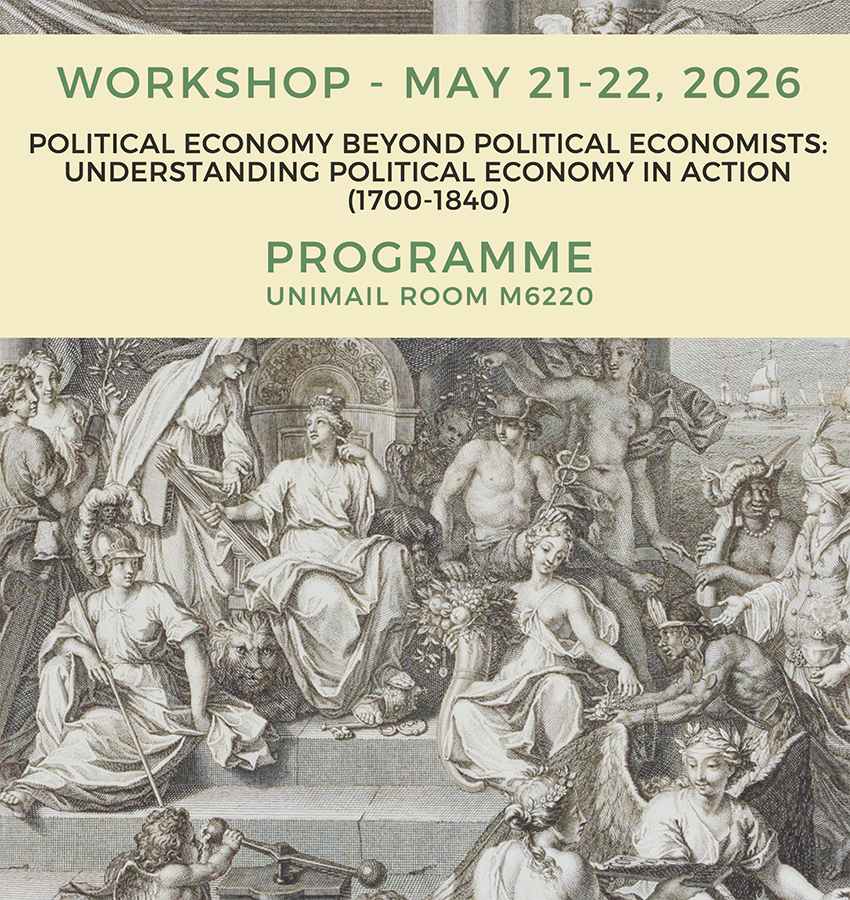
Political economy beyond political economists: understanding political economy in action (1700-1840)
40 boulevard du Pont-d’Avre
1205 Geneva, Switzerland
  |
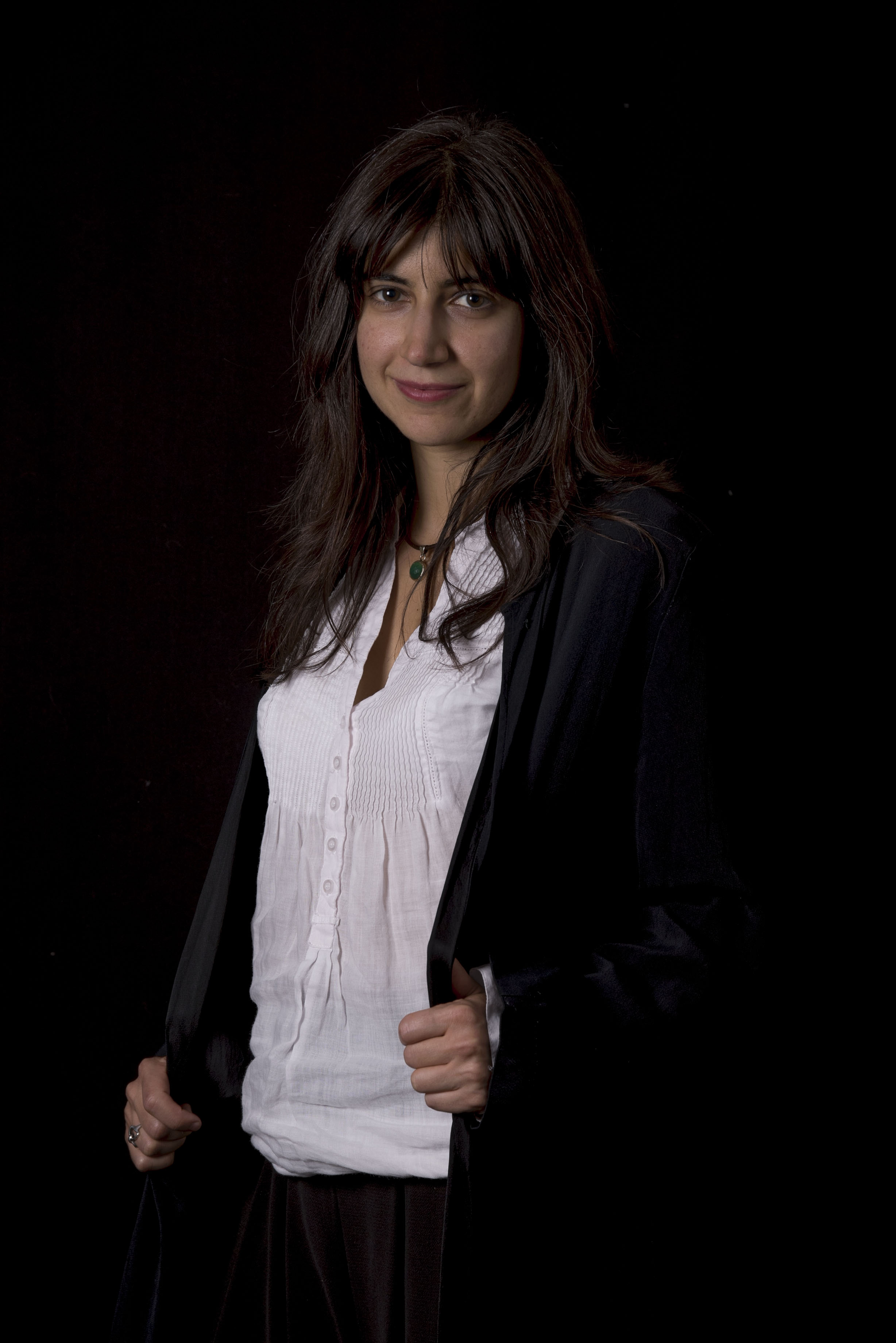
Workshop with the participation of Lavinia Maddaluno, Assistant Professor at Ca’ Foscari University of Venice, fellow for 2025-2026 at the Paris IAS.
Presentation
Between the end of the XVIlth century and the middle of the XIXth century, mounting interimperial rivalries and major economic changes (i.e., the industrial revolution) intertwined with a growing formalization of scientific knowledge and, more specifically, the emergence of political economy.
In 1776, Adam Smith famously characterised political economy as "a branch of the science of a statesman or legislator" that aims "to enrich both the people and the sovereign". However, the role of economists and the subject of their study were still very much undefined at the time. On the one hand, economics as a distinct academic discipline had yet to emerge, and the boundaries with other fields of knowledge such as moral philosophy, natural sciences, or political theology were unclear. On the other hand, discussions of provocative ideas about the origins of wealth, the regulation of markets and freedom of trade were not restricted to closed intellectual circles.
Even though most of early economic debate took place beyonp elite intellectual and political spheres, this significant yet elusive portion of economic thinking has largely escaped the attention of conventional histories of political economy. It is only in recent years that a growing stream of research has examined the emergence of economic discourse beyond the scope of prominent figures who came to define the trajectories of modern economic debates.
Building on these innovative approaches, the workshop aims to bring together historians who are working on the nexus between economic discourses and material practices in science, government, trade, manufacturing and agriculture. In studying "political economy in action", the workshop focuses on neglected actors who intervened in this emerging field of political economy. By bridging the gap between economic discourses and practices, it features new ways to study economic discourse, and to suggest what types of economic arguments played a role in reshaping economic and social practices.
Program
DAY 1- THURSDAY 21 MAY 2026
3:30 p.m.- Welcome Coffee
INTRODUCTION
4:00-4:30 p.m.- Studying Political Economy in Action
Lorenzo Avellino (Université de Genève - The Fabric of Profit)
Jean-Baptiste Vérot (Université Marie & Louis Pasteur - Centre Lucien Febvre)
SESSION 1- Freedom, Regulation & The State
4:30-5:00 p.m.- Unions for Manufacturers? The role of employment and textile manufacturing in Anglo-Scottish and Anglo-Irish Union, 1688-1720
Hugo Bromley (Université de Cambridge - Centre for Geopolitics)
5:00-5:30 p.m.- Global Trade, Smuggling, and the Making of Economic Liberalism: Asian Textiles in France 1680-1760
Felicia Gottmann (Université de Northumbria)
5:30-6:00 p.m.- The Estates of Languedoc and the governance of the woollen industry in Languedoc (1682-1789)
Flavian Minel (Université Jean Moulin Lyon 3)
KEYNOTE
6:15-6:30 p.m.- Introduction
Mary O'Sullivan (Université de Genève - The Fabric of Profit)
6:30-8:00 p.m.- The Limits of Mercantilism
Julian Hoppit (University College London)
8:15 p.m.- Dinner
DAY 2- FRIDAY 22 MAY 2026
SESSION 2: Mobilising Knowledge for Economic Improvement
9:00-9:30 a.m.- Political Economy in the Field: Natural History, Agricultural Practice, and Economic Reasoning in Northern Italy between the Age of Enlightenment and the Napoleonic Era
Luciano Maffi (Université de Parme)
Martino Lorenzo Fagnani (Université de Pavie)
9:30-10:00 a.m.- Knowledge economies of scarcity and economic projectors in eighteenth-century colonial Brazil
Lavinia Maddaluno (Paris Institute for Advanced Study)
10:00-10:30 a.m.- Founding a Cattle Civilization: Antonio Obligado's 1799 Plan for the Pampas of Buenos Aires
Mattia Steardo (Université de Milan)
10h:30-10:45 a.m.- Coffee break
SESSION 3: New Sources for the History of Political Economy
10:45-11:15 a.m.- Corporate Privileges : a Way to Investigate Political Economy in Action?
Vincent Demont (Université Paris Nanterre - Institutions et dynamiques historiques de l'économie et de la société)
Pauline Lemaigre-Gaffier (Université Paris Saclay - Institut d'études culturelles et internationales)
11:15-11:45 a.m.- Political Economy and Beyond: Petitions in the Dutch Republic and its colonies
Joris Van den Tol (Université Radboud)
11:45 a.m.-12:15 p.m.- Translating Planter Political Economy. Pierre Joseph Laborie's The Coffee Planter (1798) and the Caribbean Origins of Second Slavery
Giulio Talini (Université de Turin - Fondazione 1563)
12:15-1:15 p.m.- Lunch
SESSION 4: Political Economy From Below
1:15-1:45 p.m.- The economic turn in the scope of social conflict: Lyon and the physiocratic roots of the labour movement
Antoine Ropion (Université Lumière Lyon 2)
1:45-2:15 p.m.- "Dans les grosses fermes tout se fait à la hâte”. The Political Economy of Agronomic Innovation in Late EighteenthCentury France
Aris Della Fontana (Université Paris Nanterre - Institut des sciences sociales du politique)
2:15-2:45 p.m.- "Let Each Speak Only of What he Knows": Contesting Political Economy in early republican Latin America (Buenos Aires, 1810-1834)
Tomas Viera (Universidad de Buenos Aires)
2:45-3:00 p.m.- Coffee break
SESSION 5: Intersections of Theory and Practice
3:00-3:30 p.m.- “Hе makes trade his religion": Josiah Tucker and the merchants of Bristol (1749-1799)
Karim Ghorbal (Université Rennes 2)
3:30-4:00 p.m.- Concepts and Practice of State Intervention in Sismondi's European Network of Correspondents, 1799–1842
Gaïa Valenti (Université de Genève - The Fabric of Profit)
4:00-4:30 p.m.- Political economy, economic expertise and policy making in France (1750-1789)
Loïc Charles (Université Paris 8)
4:30-5:30 p.m.- The Democratization of Value in the French Revolution
Nicholas O'Neill (Arizona State University)
End of the worshop
Organizers
The workshop is organized by Dr Lorenzo Avellino (The Fabric of Profit – Université de Genève) and Dr Jean-Baptiste Vérot (Lucien Febvre Centre – Université Marie et Louis Pasteur).
Practical details
The workshop will be held in English at the University of Geneva (40 Boulevard du Pont-d’Avre, 1205 Geneva, Switzerland). For further information, please contact fabric-of-profit@unige.ch
|
|
 "L’art de convertir les vivres en pain": scarcity, technology and hybrid knowledge in the eighteenth-century Portuguese and French Atlantic 01 September 2025 - 30 June 2026 |
|
|