Andrew Wilson
  |
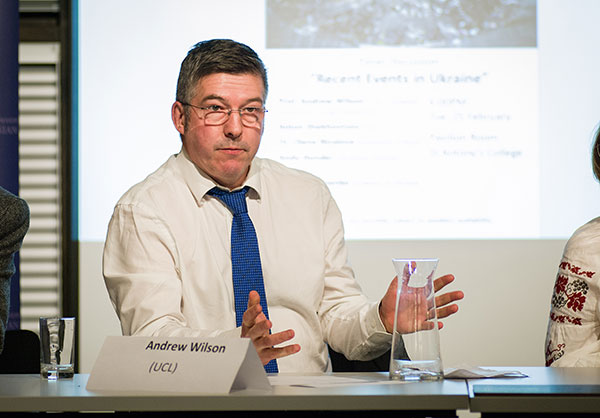
Andrew Wilson is Professor of Ukrainian Studies at University College London, and a Senior Policy Fellow at the European Council on Foreign Relations (ECFR). His most recent books are Political Technology: The Globalisation of Political Manipulation (CUP, 2024) and The Ukrainians (Yale UP, 2022). He will publish two books in 2026: Russia’s Propaganda State: How Political Technology Helped Create the War Against Ukraine (CEU Press) and Kyiv: Unbreakable City (Yale UP).
Andrew Wilson joins the Paris IAS in June 2026 for a one-month writing residency.
Research topics
Russian Political Technology; Russian Political Warfare; Russian FIMI against the West.
Russian Political Warfare
Russian subversion operations against other states have been described under many labels. FIMI, information war, hybrid war, political technology (Wilson 2024) and political warfare (Shekhovstov 2023).
For the purpose of definitions and model-building, this project will compare Russian influence operations against three states: the USA, Moldova and Ukraine. Research trips were undertaken in the USA in January 2025 and January 2026, in Moldova in October 2024 and May 2025, and will be undertaken in Ukraine in February 2026. Evidence collected includes: elite interviews with political and security officials and experts, legal cases against Russian entities and studies of social media platforms and content.
The project will argue that Russian operations in the USA can mainly be classed as ‘secondary infection’, the injection of anti-Ukrainian narratives into pre-existing US media, particularly the ‘MAGAphone’, new media built up to compensate for the exclusion of Trump and others from Twitter, etc after January 2021. As such, its impact is hard to judge, but it is Trump supporters, not Republican voters as a whole, whose attitudes toward Ukraine have hardened since 2022. In Moldova, Russia has had more freedom to engage in political warfare engineering, creating and promoting new political subjects: political parties, NGOs, media, attempting to steer the local Orthodox Church. All coordinated by two giant structures: the ‘Šor Network’ of money and grass-roots (astroturf, artificial grass roots) organisation, and a new Kremlin GONGO called ‘Eurasia’, a giant holding company for influence operations. The research of Andrew Wilson in Moldova also looked at impact, and how a small state’s counter-measures proved effective.
Third will be Ukraine, in terms of existing Russian operations and how Russia might seek to reestablish influence if the domestic political process is unfrozen after any peace agreement, especially if there are new elections. Evidence collected so far suggests a combination of the USA and Moldova models. Ukraine’s wartime measures – banning of some parties, expropriation of some oligarchs, corralling of the main TV stations into the national news ‘Marathon’ – mean that Russia will not have the political space to operate on the scale that it has in Moldova. Russia will mainly pursue secondary infection: pushing disinformation and undermining any peace deal in social media. But it will have some scope for kinetic operations: backing a local ‘peace’ (meaning anti-war) party, backing anti-European/American nativists, stirring bilateral disputes with neighbours, and undermining support for Ukraine in EU countries.
The three case-studies will produce two comparative maps. The first showing Kremlin decision-making – just who is responsible for which operation. The second showing comparative impact – how political and media subjects have been shaped or distorted in the three target states.
After completing his research in February 2026, a stay with the Paris IAS would allow the fellow to write up the results in Spring 2026, in time for Western countries to react to a potential ‘hybrid peace’. Even if Russian military operations against Ukraine have stopped, Russia will be using political warfare to undermine Ukraine’s domestic political order.
Key publications
Andrew Wilson, Russia’s Propaganda State: How Political Technology Helped Produce the War Against Ukraine, Central European University Press, 2026.
Andrew Wilson, Political Technology: The Globalisation of Political Manipulation, Cambridge University Press, December 2024.
DOI: doi.org/10.1017/9781009355308
Andrew Wilson, Virtual Politics: Faking Democracy in the Post-Soviet World, Yale University Press, 2005.
DOI: doi.org/10.1111/J.1468-0491.2006.00333_6.X
 Online conference by Andrew Wilson, Professor of Ukrainian Studies at University College London, and fellow for a one-month writing residency as part of the "Paris IAS Ideas" series. Open to the public. |
|
|
|
|