
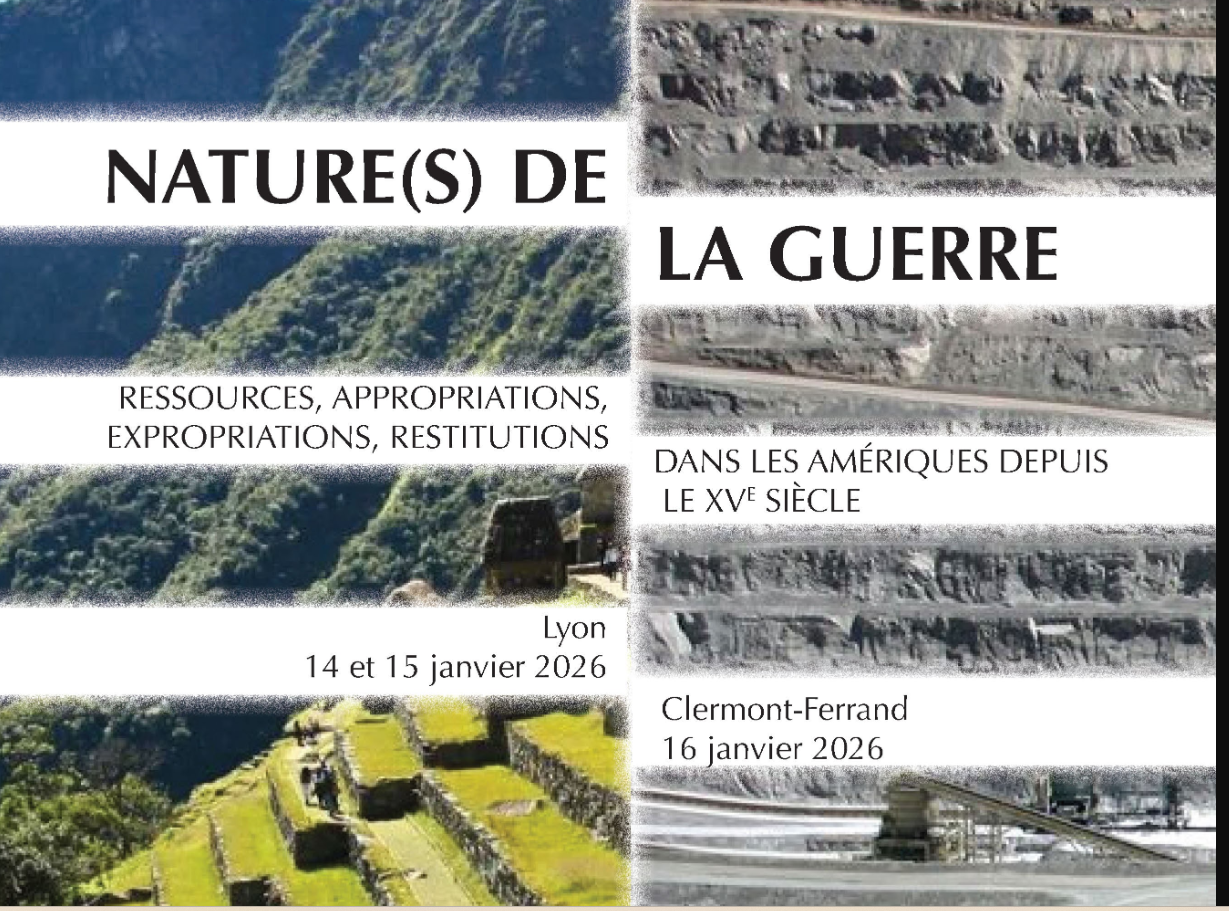
Nature(s) de la guerre. Ressources, appropriations, expropriations et restitutions dans les Amériques
46 allée d’Italie
69007 Lyon
  |
Lecture by Lavinia Maddaluno, 2025-2026 fellow at the Paris IAS, assistant professor at Ca' Foscari University in Venice, as part of the symposium organised by Samir BOUMEDIENE (ENS Lyon – IHRIM), Thomas BRIGNON (University of Clermont-Auvergne – IHRIM), Samira RIAHI, Frédéric VIGIER and Alla ZHUK (LabEx COMOD) at ENS Lyon.
Presentation
The referendum organised by the Venezuelan government at the end of 2023 on the annexation of Essequibo, Guyana, served as a reminder that 19th-century borders are still open to dispute. In fact, the capture of hydrocarbons or rare metals has been the material basis for several recent conflicts, and global warming, with the spectre of ‘water wars’, seems to reinforce these issues. In this sense, this conference comes at a time of crisis and indecision: ecological disasters may suggest that awareness of a greater danger will be able to put an end to wars, or that, on the contrary, they will only exacerbate tensions. Faced with such an urgent situation, the best contribution that the social sciences can make is to better define certain concepts by comparing case studies.
Bringing together specialists from different periods and disciplines (anthropology, archaeology, history, geography, political science, sociology), this conference examines the relationship between warfare and the environment and, to this end, attempts both to bring into dialogue and to distance two approaches to the problem. The first, more traditional approach attributes the outbreak of conflicts to objectifiable pressure on “resources”. Despite the clarity it provides, this approach assumes too strongly that scarcity inevitably leads to war and that all parties involved in a conflict perceive it in the same way. From this point of view, the great merit of the second approach, which draws more heavily on anthropology, has been to pluralise the relationship with “nature”, in particular by challenging the primacy that Western societies accord to the economy. However, this approach runs the risk of sometimes underestimating the material dimension of war and, above all, of substituting the description of situations with a more prescriptive stance consisting, for example, of changing ontology, imagination or narrative.
The American continent offers an interesting field of study for thinking between these approaches. Not only because of colonisation, mining extractivism, the plantation economy or wars caused by products such as rubber. But also because of the multitude of relationships with plants, animals, rivers, winds and stars, which, even before the conquest, after independence and up to the present day, have shaped original ways of confronting and regulating conflicts. The title of this conference, ‘Nature(s) and War,’ therefore refers both to the need to address the environmental impact of military action and to understand it differently, by showing that armed confrontation is only one form of warfare among many.
Program
2 pm : Keynite lecture by Frédéric SPILLEMAEKER (IFEA, Bogotá)
« À la lisière des nations, au cœur des ressources : les peuples amérindiens de l’Orénoque (Colombie et Venezuela) face aux guerres (du XIXe siècle à nos jours) »
3.45 pm-4.45 pm : Prises de guerre
with Andrés VÉLEZ POSADA (u. EAFIT, Medellín)
« Esmeraldas en los Andes septentrionales : guerras, valores, usos. »
with Aliocha MALDAVSKY (u. Paris-Nanterre)
« Restitutions de biens aux Indiens et mémoire des guerres de conquête dans les Andes aux XVIe et XVIIe siècles »
5 pm-6.30 pm : Temps de guerre
with Antoine DURANTON (EHESS)
« Déraciner, enraciner. Réflexions sur la place des plantes dans la conquête. »
with Sergio OROZCO-ECHEVERRI (u. de Antioquia)
« Shared time, unequal worlds : environmental temporality and the making of colonial order in Early Modern Iberian America »
with Lavinia MADDALUNO (Paris IAS & u. Ca’ Foscari)
« Réorganiser le savoir : subsistance, disette, pain et pommes de terre dans les Antilles françaises (XVIIIe siècle) »
|
|
 "L’art de convertir les vivres en pain": scarcity, technology and hybrid knowledge in the eighteenth-century Portuguese and French Atlantic 01 September 2025 - 30 June 2026 |
|
|