
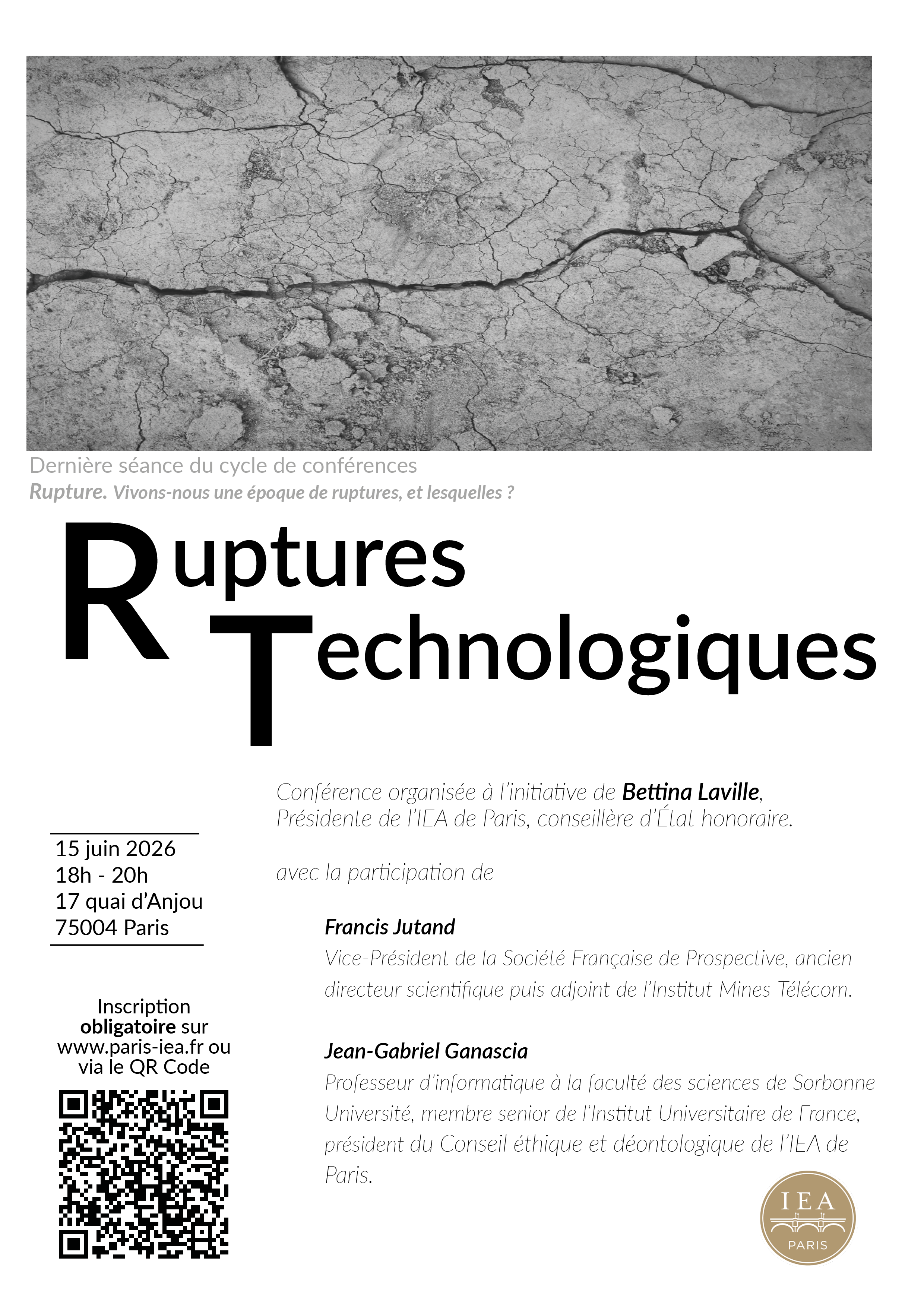
Ruptures technologiques
Gardes Room - 1st floor
Hôtel de Lauzun
17 quai d'Anjou
75004 Paris
  |
Presentation of the session
For this final session, we will examine technological breakthroughs, which, for some, could change the human species or the functioning of the brain, and, for others, represent a true revolution in human emancipation.
Hosted and organised on the initiative of Bettina Laville, President of the Paris IAS and Honorary Member of the Council of State, this session will feature Francis Jutand, Vice-President of the Société Française de Prospective, former Scientific Director and subsequently former Deputy Director of the Institut Mines Télécom, and Jean-Gabriel Ganascia, Professor of Computer Science at the Faculty of Sciences of Sorbonne Université, Senior Member of the Institut Universitaire de France, and Chair of the Ethics and Professional Conduct Committee of the Paris IAS.
Presentation of the speakers
Francis Justand
A graduate of the École normale supérieure de Cachan (where he obtained an agrégation in applied physics in 1974 and a DEA in optics in 1975), he worked in the field of digital education and research at Télécom Paris, before going on to head up Télécom Bretagne. He served as Scientific Director of the Orange R&D Centre, the digital department of the CNRS, the Institut Télécom and subsequently the IMT, where he later became Deputy Director General in charge of strategy and development. He chaired the ANR’s Digital Scientific Council. He founded the Cap Digital competitiveness cluster and was involved in the creation of the Institut Carnot Télécom et Société Numérique. He was a member of the National Digital Council and is the editor of the collective work La Métamorphose numérique. Vers une société de la coopération et de la connaissance.
With a focus on digital technology, infrastructure, data, artificial intelligence and applications, he is one of the founders of the Chair on ‘Personal Data and Digital Identities’ and the Chair on ‘The Economy of Data Commons’ at the IMT.
Currently Vice-President of the Société Française de Prospective, he works on the digital transformation of society and AI and its impacts, and has just published the report L'IA des Lumières, released during the International Summit on Artificial Intelligence (AI Action Summit) and produced with the support of the Cap Digital cluster.
Jean-Gabriel Ganascia
Professor of Computer Science at the Faculty of Sciences at Sorbonne Université, Jean-Gabriel Ganascia conducts his research on artificial intelligence at the Paris 6 Computer Science Laboratory (LIP6), where he heads the ACASA team (Cognitive Agents and Automatic Symbolic Learning). A recognised specialist in artificial intelligence, machine learning and data mining, his work focuses on computational philosophy and the ethics of information and communication technologies. Chair of the CNRS Ethics Committee (COMETS), he is the author of numerous books, including the seminal L'Âme machine (Seuil, 1990).
He served as a member of the CNRS Ethics Committee (COMETS) from 2011 before assuming the chairmanship until 2021. He is currently a senior member of the Institut Universitaire de France, a member of the National Steering Committee on Digital Ethics (CNPEN), chair of the steering committee of the Cycle des Hautes Études de la Culture (CHEC) and president of the French Association for the Advancement of Science (AFAS). He is Chair of the Paris IAS’s Ethics and Professional Conduct Committee and was patron of the 2024–2025 cohort of fellows.
Presentation of the cycle
We often hear that "we are living in an era of disruption(s)" or that "we are living in an era of transition", expressions that tend to replace what was still prevalent two or three years ago. However, these two movements are simultaneously visible: they complement each other and sometimes clash.
Prime Minister Sébastien Lecornu, on the steps of Matignon, declared on 10 September: "We will need ruptures, and not just in form, and not just in method. We will also need to make fundamental changes." For his part, Canadian Prime Minister Mark Carney began his speech at the Davos Forum by saying: ’We are in the midst of a rupture, not a transition."
We can see that the concept of change, perceived by people and leaders as hope, threat or vertigo, deeply influences thinking about our times. Christian Salmon, writer and researcher, even describes it as a "true anthropological change". Indeed, the reversal of values and the distortion of reality extend this anthropological change to many areas of our lives, both public and private.
Organised by Bettina Laville, President of the Paris IAS and Honorary State Councillor, this series of meetings consists of four sessions devoted to the analysis of contemporary transformations. It explores the notions of rupture and transition, perceived as hopes, threats or vertigo, and their impact on values, society and everyday life. The discussions will draw on intellectual, political and anthropological perspectives to understand the profound dynamics that shape our era.
Practical information
Sessions will be held in person only at the Paris Institute for Advanced Studies (Paris IAS, Gardes Room - 1st floor, Hôtel de Lauzun, 17 quai d'Anjou, 75004 Paris)
Admission by registration only (dedicated registration form for each session - limited places).
For more information, please contact information@paris-iea.fr
Due to its classification as a historic building and current regulations, smoking is prohibited (inside and in the courtyard), as is eating and drinking in the conference room and wearing high heels.
|
|
|
|
|
|