
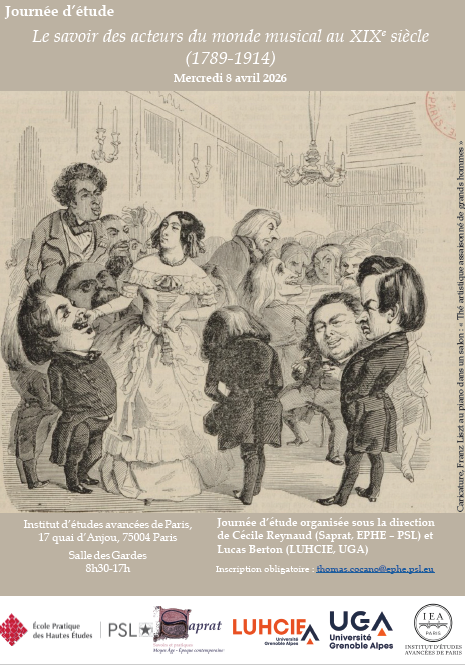
Le savoir des acteurs du monde musical au XIXe siècle (1789-1914)
Hôtel de Lauzun
17 quai d'Anjou
75004 Paris
  |
Presentation
This seminar examines the knowledge and extra-musical culture of key figures in the musical world during the 19th century (1789–1914), including composers, performers, musicologists and music theorists, critics, conductors, publishers and newspaper editors, instrument makers and luthiers, concert hall managers and librarians. In order to assess the scope of this knowledge, we will consider both academic knowledge (public and private lessons, personal libraries as well as those of institutions such as the Conservatoire, etc.) and cultural knowledge (travel, participation in social circles and salons, reading, exhibitions). Whilst texts written by and about these figures constitute primary sources of great importance, musical scores can also represent an essential source; their study offers the possibility of identifying specific areas of knowledge (for example, the titles of works indicating literary, philosophical, historical or pictorial inspirations, and quotations and epigraphs incorporated into the score that may reveal certain insights). The various ways of acquiring knowledge will be taken into account: family circle, studies, public or private lessons, reading, social circles, travel, and visits to museums or artists’ studios. The social emancipation of the musician in the 19th century—who in the past was often linked to princely courts, institutions or patrons—may have simultaneously fostered intellectual emancipation, as means of democratising knowledge developed over the course of the century, such as the proliferation of newspapers and journals. By striving to provide an objective view of the knowledge possessed by these figures in the musical world, this conference will, more generally, enable us to grasp, through the diversity of the cases studied, what scholarship, science, shared culture and the possibilities for the construction of knowledge represented in the 19th century.
Program
Morning
8.30am: Welcome
9.00am: Emmanuel Reibel (ENS Lyon, IHRIM)
L’érudition littéraire de la compositrice Louise Bertin
9.30am: Rosalba Agresta (BNF Iremus / EPHE – PSL, Saprat)
Savoir, sociabilités et création chez Pauline Viardot
10.00am: Lucas Berton (Université de Grenoble Alpes, LUHCIE)
Franz Liszt lecteur de l’oeuvre de Victor Hugo. Regards sur une culture littéraire
10.30am-11.00am Coffee break
11.00am: Etienne Jardin (Palazzetto Bru Zane)
Les enseignements non-musicaux des conservatoires français au XIXe siècle
11.00am: Christophe Corbier (CNRS, IReMus)
Rythmique et métrique dans les théories de FA Gevaert. Musique et philologie
12.00pm: Hector Cornilleau (EHESS, Centre Georg Simmel)
François-Joseph Fétis, théoricien et artisan : du « cabinet d’études » aux matériaux des savoirs techniques
12.30pm-1.00pm: Questions and discussion
1.00pm-2.30pm
Lunch
Afternoon
2.30pm: Marie-Gabrielle Soret (BnF, IReMus)
Camille Saint-Saëns, musicien savant et savant musicien
3.00pm: Emmanuelle Blasutta (EPHE – PSL, Saprat)
Paul-César Gibert dramaturge
3.30pm: Cécile Reynaud (EPHE – PSL, Saprat)
Les savoirs de Berlioz
4.00pm-4.30pm: Questions et discussion
Conclusion of the day
Organisers
Under the direction of Cécile Reynaud (cecile.reynaud@ephe.psl.eu; Saprat, EPHE – PSL) and Lucas Berton (lucas.berton@univ-grenoble-alpes.fr; LUHCIE, UGA), the conference is organised by the Saprat and LUHCIE research groups, with the support of the Paris Institute for Advanced Studies.
Pratical terms
The seminar will take place in person at the Paris IAS (Salles des Gardes, 1st floor, 17 quai d'Anjou, 75004 Paris).
Event open to the public
Registration is required for this event. Please send an email to: thomas.cocano@ephe.psl.eu
|
|
|
|
|
|