
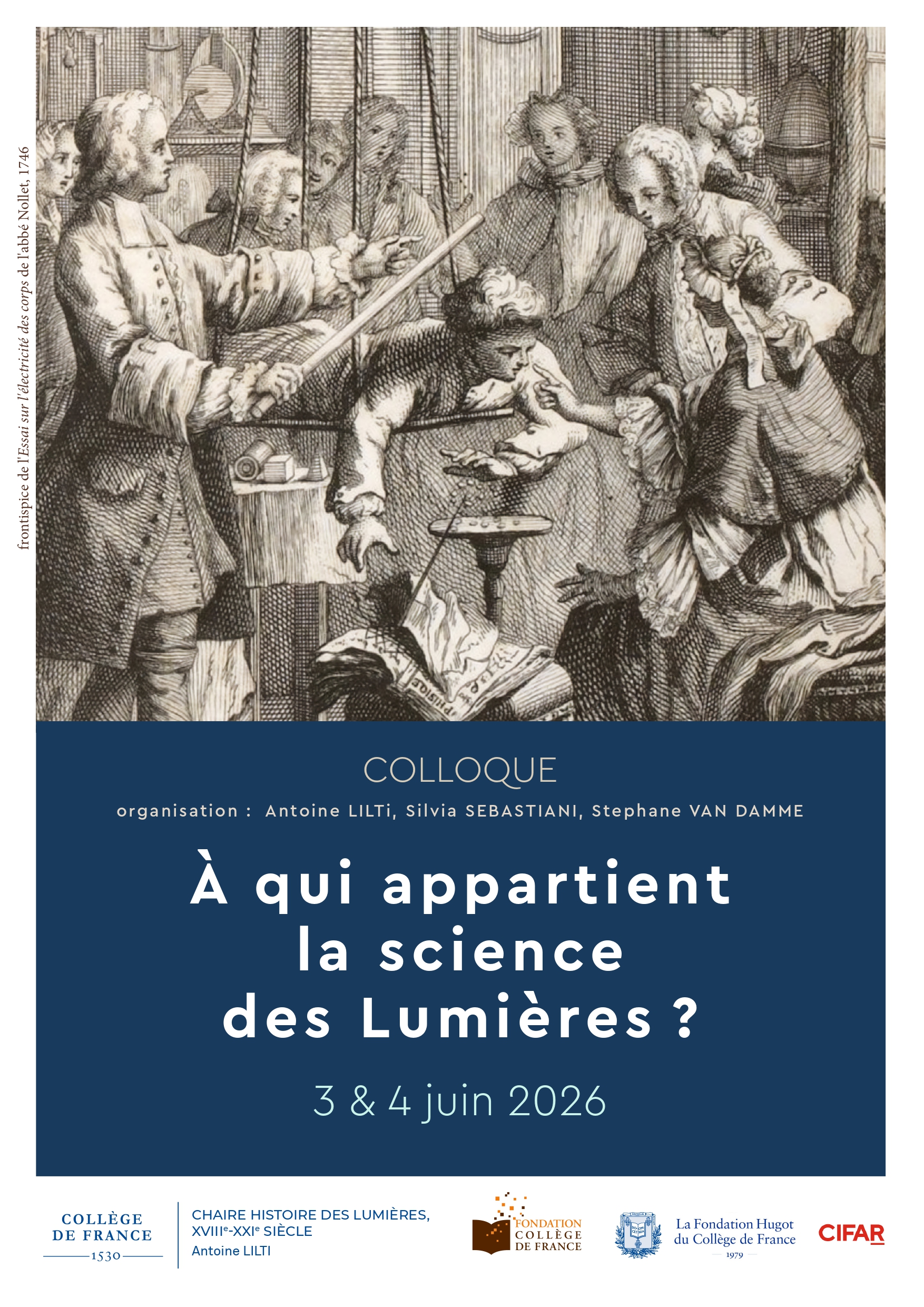
À qui appartient la science des Lumières ?
11 Place Marcelin Berthelot
Amphithéâtre Marguerite de Navarre
Site Marcelin Berthelot
75231, Paris
  |
Colloque organised by the Collège de France, with a presentation by Lavinia Maddaluno (Ca' Foscari University of Venice, Paris IAS).
Presentation
In 1738, in his book Elements of Newton’s Philosophy Made Accessible to Everyone, Voltaire justified his endeavor as follows: “The science of nature is a good that belongs to all mankind.” This does not mean that everyone can contribute to it equally, but that everyone has the right to know its findings. The universality of science does not rest solely on its ability to establish laws valid everywhere and at all times; it implies that the knowledge produced must be universally shared, that it must become a common good. The Newtonian, then Lavoisian and Linnaean paradigms, which have so often served as models for the definition of modern “science,” have long been associated with the requirement that scientific knowledge be made public: this knowledge must be made available, both materially and intellectually, through intermediaries such as Voltaire, in order to allow everyone—and particularly those who have neither the means nor the time to delve into the details of the calculations—to have “knowledge of their own good.”
This ideal of openness and public access from the Enlightenment clashed with the supposed closed nature and culture of secrecy surrounding artisanal knowledge, as well as with the hierarchy and selectivity of scholarly institutions. Yet these divisions were the subject of intense debate. While the public accessibility of science lies at the heart of the Enlightenment project, it has, since the 18th century, posed as many problems as it has solved. Who will present the findings? Who will be responsible for publishing scientific results? Can the public settle disputes among scholars? The public’s entry onto the scholarly stage transforms the social boundaries of its analysis: what role do women, amateurs, and artisans play in this scholarly world that is both becoming increasingly specialized and open to the public? What is the place of lay knowledge in the scholarly world of the Enlightenment? Can the dissemination of science escape being turned into a spectacle, oversimplified, or exploited by pseudo-scholars and charlatans? This social opening, driven by the new approaches of the Enlightenment, thus leads to a questioning of the very category of science itself. Today’s issues are no longer those of the cultural turning point of the 1990s, and this conference will provide an opportunity to discuss the perspectives opened up, for example, by reflections on scientific commons, science funding, the utility of science, or intellectual property.
This event will take place over two days: Wednesday, June 3, and Thursday, June 4.
Program
Day1- Wednesday, June 3
9:00 a.m.-9:30 a.m.: Introduction
Antoine Lilti, Silvia Sebastiani & Stéphane Van Damme
9:30 a.m.-10:00 a.m.: Les dilemmes du primate autodidacte, ou la politique de la science à l’ère du transformisme
Jessica Riskin
10:00 a.m.-10:30 a.m.: Connaître le cerveau, déterminer la race : autorité des savoirs médicaux
Maxime Guttin
10:30 a.m.-11:00 a.m.: "The Wisest Man Nevertheless Knows Not the Nature of A Fever." Epistemic Geographies and Enlightened Disputes
Stefanie Gänger
11:15 a.m.-12:00 p.m.: Discussion
Antoine Lilti
2:00 p.m.-2:30 p.m.: Le voyage des trois moutons tibétains : science et élevage dans l’empire français des Lumières
Jens Amborg
2:30 p.m.-3:00 p.m.: Entre amélioration et appropriation de la nature : la sylviculture, une autre "science aimable" ?
Émilie-Anne Pepy
3:00 p.m.-3:30 p.m.: Discussion
Antoine Lilti
3:45 p.m.-4:15 p.m.: Connecter ou déplier ? Les archives de l’autochtonie dans l’océan Indien
Gregory Quenet
4:15 p.m.-4:45 p.m.: L’Indien écologique est-il une fable des Lumières ? Altérité et savoirs autochtones sur l'environnement
Jan Synowiecki
4:45 p.m.-5:15 p.m.: Discussion
Antoine Lilti
5:30 p.m.-6:30 p.m.: Les fausses lueurs : rumeur et réputation dans les sciences des Lumières
Simon Schaffer
Day 2- Thursday, June 4
9:30 a.m.-10:00 a.m.: Curiosités et savoirs européens à l’épreuve des objets sonores océaniens (fin XVIIIe– début XIXe siècle)
Mélanie Traversier
10:00 a.m.-10:30 a.m.: Hidden treasures. Some Mexican ruins and a Peruvian Tableau (c. 1800)
Juan Pimentel
10:30 a.m.-11:00 a.m.: Enlightened ideas in the Indian Ocean Arena: Thinking with the Small
Sujit Sivasundaram
11:15 a.m.-12:00 p.m.: Discussion
Antoine Lilti
2:00 p.m.-2:30 p.m.: Du travail collectif au mythe du génie solitaire : la « révolution chimique »
Francesca Antonelli
2:30 p.m.-3:00 p.m.: Décrire des savoir-faire, publier des sciences : le vert-de-gris dans le Montpellier des Lumières
Pierre-Yves Lacour
3:00 p.m.-3:30 p.m.: Entre sciences et spectacles : les séances publiques du Collège de France (1780-1803)
Jean-Luc Chappey
3:45 p.m.-4:30 p.m.: Discussion
Antoine Lilti
4:30 p.m.-6:00 p.m.: Round table and final discussion
Shiru Lim, Lavinia Maddaluno, Neil Safier & Nathalie Vuillemin
|
|
 "L’art de convertir les vivres en pain": scarcity, technology and hybrid knowledge in the eighteenth-century Portuguese and French Atlantic 01 September 2025 - 30 June 2026 |
|
|