
Autour d'Antoine Lasalle (1754-1829), littérateur philosophe, traducteur, expérimentateur
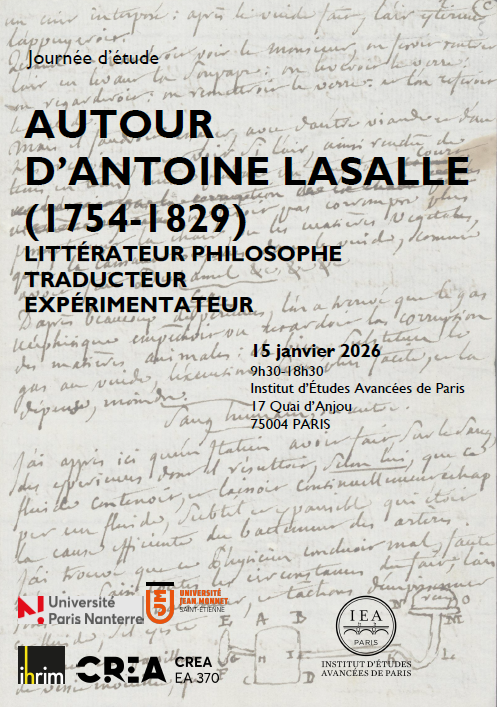
17 quai d'Anjou
75004 Paris
  |
Presentation
For Dominique Garat, who catalogued his works, Antoine Lasalle presented himself to the public “with Bacon in hand,” as D'Alembert and Diderot had done before him, and thus seemed a natural successor to them. As the author of a fifteen-volume translation of the works of Francis Bacon, published between 1799 and 1803, Antoine Lasalle brought to fruition a project long dreamed of by the encyclopedists before him. Expressed on several occasions, the translator's intention was to educate “all reasonable classes of society,” and more particularly women and young people. This desire for emancipation through education had in fact been at the heart of Lasalle's project since the late 1780s, as evidenced by the publication of three extensive treatises (in 1786, 1788, and 1789) that allow us to follow the translator's project from its initial formulation. Indirectly, these essays also reveal the personality of a “literary philosopher” for whom writing was an irrepressible extension of the activity of translation. For “the Bacon of France,” as his friend Jean-Baptiste Gence would call him, saw the essay as a place to test the English philosopher's theses as well as a space for dialogue with the thinkers of his time—whom he spared little criticism. In the form of a conversation between equals with his audience, whom he invites to be wary of the authority of their “masters,” the author of La Balance naturelle constantly proclaims the primacy of personal experience. His own writings are an illustration of this freedom of thought, offering a continuation not only of a practice of reading and translation but also, by other means, of the travels of his youth, the public science lectures he attended, and the experiments he conducted himself—right up to the Nouvelles récréations mathématiques of 1798, a variation on “fun science” books that place interest and play at the foundation of education. By highlighting Antoine Lasalle's direct influence on the thinking of the Ideologues and the physico-moral school, but also by revisiting lesser-known works such as La Théorie de l'ambition (1802)—whose authorship has long been debated—this study day aims to highlight the coherence and originality of an intellectual journey during the Revolution.
Program
9.30 am - Welcome (with coffee)
10.15 am - Sylvie KLEIMAN-LAFON, Paris-Nanterre University
Présentation du livre « Antoine Lasalle, traducteur de Francis Bacon. Politiques de la science sous la Révolution et l’Empire »
11 am - Jean-Luc CHAPPEY, Paris I-Panthéon Sorbonne University
« Traduire en Révolution : enjeux politiques et intellectuels »
11.45 am- Lisa ROUGETET, The University of University of Western Brittany
« Les Nouvelles récréations mathématiques d'Antoine Lasalle, ou le contre-pied d'un genre éditorial fondé sur la pédagogie, la pratique ludique et le spectacle expérimental »
12.30 pm - Questions
Lunch
2.15 pm - Grégoire TAVERNIER, Orleans University
« Inciter ou démystifier ? La Théorie de l’ambition, ou les paradoxes d’un volontarisme rabat-joie »
3 pm - Gabrielle BORNANCIN-TOMASELLA, University of Saint-Etienne
« Un ‘précepteur’ sans ‘prestige’ ? L’émancipation intellectuelle par la méthode dans Le Désordre régulier »
3.45 pm - Lucien DERAINNE, University of Saint-Etienne
« Pourquoi rééditer Lasalle aujourd’hui ? »
4.30 pm - Questions
End of the day
Conditions of participation
Registration is required. Please register at least 72 hours in advance at the following address: s.kleimanlafon@parisnanterre.fr
Organization
- Sylvie KLEIMAN-LAFON (PR Paris Nanterre University, CREA-Centre de Recherches Anglophones).
- Gabrielle BORNANCIN-TOMASELLA (Postdoctorante, UJM Saint-Étienne, IHRIM).
- Lucien DERAINNE (CPJ LISAMO, UJM Saint-Étienne, IHRIM).
|
|
|
|
|
|