
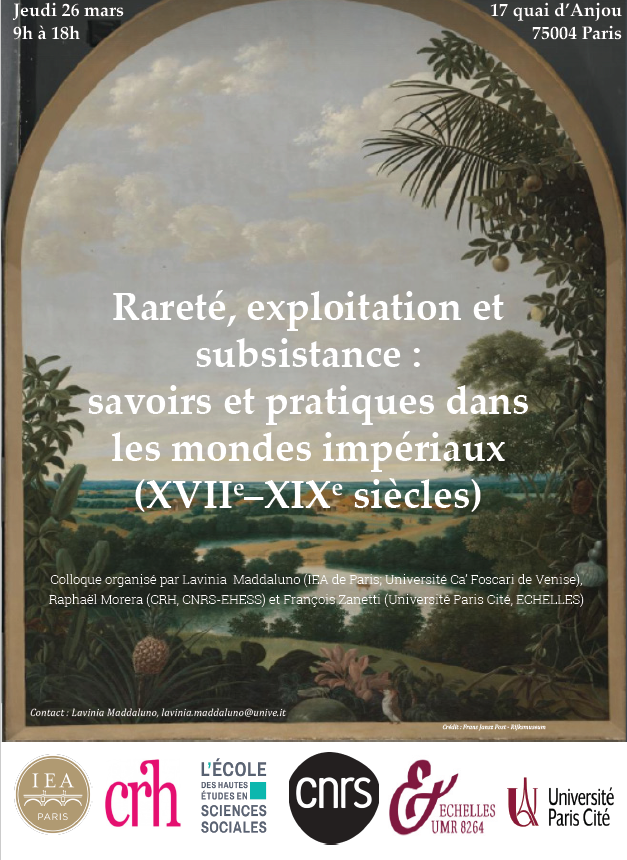
Rareté, exploitation et subsistance: savoirs et pratiques dans les mondes impériaux (XVIIe–XIXe siècles)
Hôtel de Lauzun
17 quai d'Anjou
75004 Paris
  |
Symposium co-organised by Lavinia Maddaluno (Paris IAS, Ca' Foscari University of Venice), Raphaël Morera (CRH, CNRS-EHESS) and François Zanetti (Université Paris Cité, ECHELLES), with the support of the CRH (EHESS) and ECHELLES (Université Paris Cité) laboratories.
Closed to the public in person. Can be followed via Zoom.
See Terms and Conditions below.
Presentation
As highlighted in the European Union's agenda for 2024–2029, and in particular the SDGs (Sustainable Development Goals) ‘Zero Hunger’ and ‘Responsible Consumption’, food scarcity remains at the heart of modern political economy and contemporary policy-making. More broadly, the concept of scarcity, whether of food or other resources, has recently attracted growing interest in the historiography of environmental history, knowledge and colonial empires.
In this context, global and comparative histories play a central role, highlighting the multiple issues embodied in the concept of scarcity at different scales and in different geographical areas. The English equivalent of the term, scarcity, derived from the Old French escarceté, originally referred to a ‘shortage of supply’ or a famine, thus indicating a chronologically limited moment, to be followed by a period of abundance. However, in the 19th century, classical economics contributed to ‘essentialising’ the notion of scarcity, making it one of its fundamental postulates, reflecting the tension between supply and demand. It thus transformed it into a general condition structuring the relationship between economy and society, i.e. the multiple negotiations between social actors faced with the processes of extraction and management of natural resources.
This study day offers a reflection on the ways in which scarcity was conceived, governed and constructed in the empires of the modern era. It brings together historians to discuss the material, social and political dimensions of scarcity, at the crossroads of environmental, economic, colonial and knowledge history. Structured around three thematic sessions (‘Scarcity and Resources’, ‘Population and Subsistence,’ ‘Thinking and Governing Scarcity’), the workshop examines the tensions related to the exploitation of natural resources, food shortages, labour shortages, and the representation (both cartographic and conceptual) of scarcity in different imperial and colonial contexts as well as in plantation economies. Case studies, ranging from Brazil to North America via the Portuguese and French empires, cover a broad chronological arc from the 17th to the 19th century and highlight the circulation of knowledge, practices, and mechanisms of government. The JE also aims to pose a more fundamental question: that of identifying the different categories of actors and their respective roles in problematising scarcity, as well as in the production, circulation, and implementation of the knowledge and practices mobilised to respond to these challenges.
Co-organised by Lavinia Maddaluno, Raphaël Morera and François Zanetti, with the support of the CRH (EHESS) and ECHELLES (Université Paris Cité), the workshop will conclude with a round table discussion moderated by Steven Kaplan. By questioning scarcity not as a simple ‘lack,’ but as a historical construct central to imperial logic, aimed at legitimising the exploitation and extraction of natural resources in overseas colonies, this meeting aims to renew the analysis of the relationships between exploitation, subsistence and power.
Program
Welcome and coffee
9.00am.-9.45am
Introduction by Lavinia Maddaluno (Paris IAS, Ca' Foscari University of Venice)
9.45am-10.15am
Session 1
Rareté et ressources
10.15am – 11.30am
Discussant: Raphaël Morera (EHESS; CNRS-CRH)
Claudia Damasceno Fonseca (EHESS; CRBC)
- Les mangroves de Bahia: exploitation et raréfaction des ressources (Brésil, XVIIe-XVIIIe siècles)
Louise McCarthy (Sorbonne Université, VALE/Université Paris Cité, ECHELLES)
- English colonists in the pursuit of abundance in ‘virgin land’ in early 17th-century North America
Session 2
Population et subsistance
11.45am-1.00pm
Discussant: Elisa Lopes da Silva (Universidade Nova de Lisboa; IHC)
Patrícia Martins Marcos (Université de Oklahoma, EUA)
- “All are useful, all are men, and all are good:” Population Scarcity and Racial Tinkering in Eighteenth-Century Brazil
Alessandro Stanziani (EHESS; CNRS; CRH)
- Pénuries de bras ou de nourriture? Le dilemme du XIXe siècle.
Lunch for the participants
1.00pm-2.30pm
Session 3
Penser et gouverner la rareté
2.30pm – 4.10pm
Discussant: François Zanetti (Université Paris Cité, ECHELLES)
Alvise Capria (EHESS; Lier-Fyt)
- De l’état de nature à la discipline du travail: la rareté comme dispositif de gouvernement
Rachel Tils (Université de Chicago)
- Internal Economies, Policing, and Food Scarcity under Slavery in the Eighteenth-Century Antilles, 1776-1789
Gilles Narcy (Université Paris 1 Panthéon-Sorbonne/Università degli Studi di Milano-Statale)
- Le mirage du riz sec: acclimatation impériale, déconnexion des savoirs et solutionnisme dans l’époque des Lumières coloniales
Concluding remarks and discussion
4.45pm-6.00pm
Steven Kaplan (Cornell University)
With the participation of :
Pietro Corsi (EHESS)
Luca Mocarelli (University of Milano Bicocca)
Terms and conditions of participation
The event is closed to the public in person. However, a Zoom link is available for those who wish to participate.
For any requests to participate or for information about the event, please contact Lavinia Maddaluno by email: lavinia.maddaluno@unive.it
|
|
|
|
|
|