
Guillaume Sauvé
  |
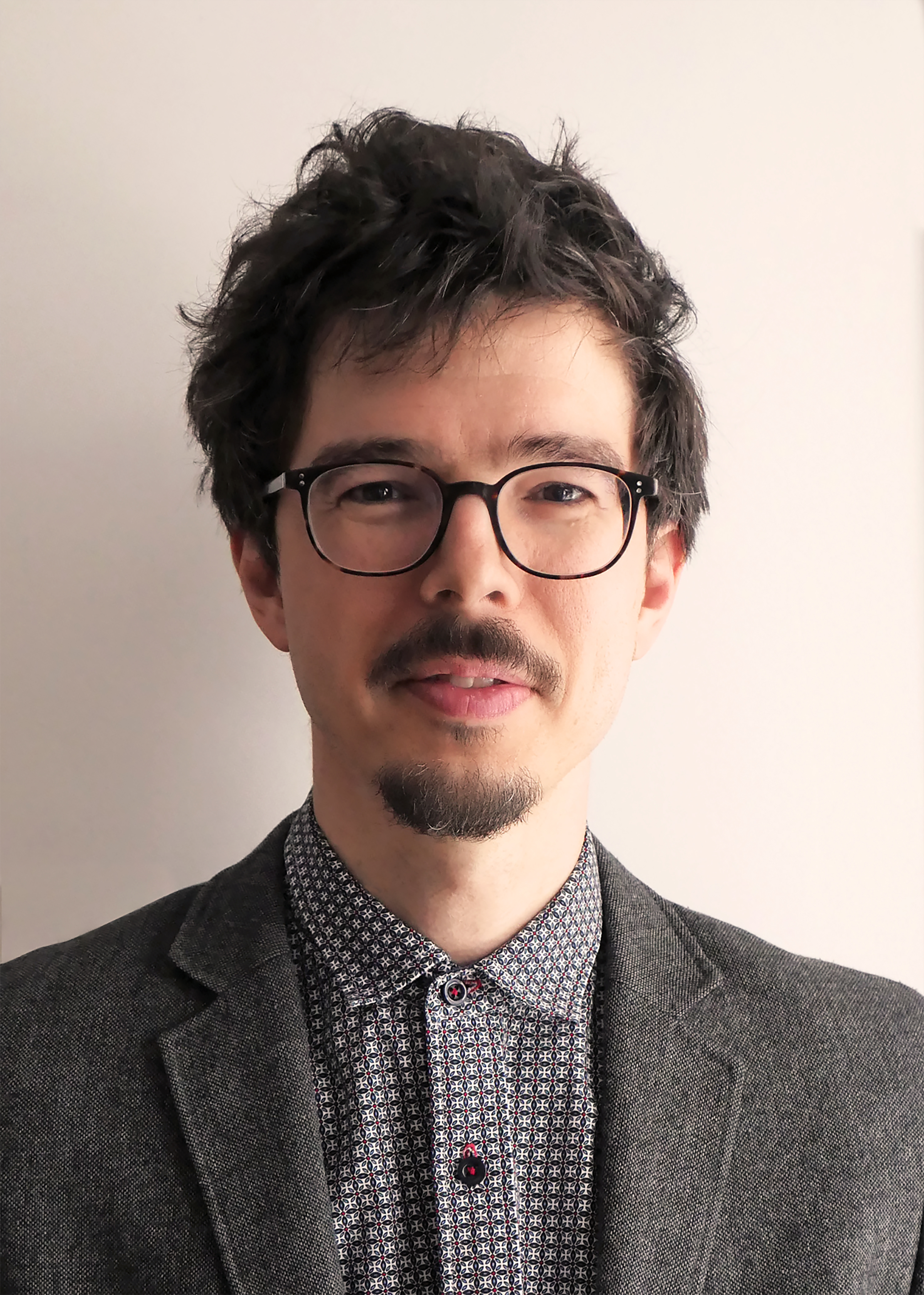
Guillaume Sauvé is a researcher and lecturer in political science at the Université du Québec à Montréal and a lecturer in international studies at the Université de Montréal. His research lies at the intersection of comparative politics, political sociology, and intellectual history, with a focus on late Soviet and post-Soviet Russia. Drawing on archival research and interviews, he also integrates methods from the digital humanities.
His first book examines the paradoxical role of Soviet liberals in both promoting and constraining the emergence of democracy in Russia during and after perestroika (1987–1993). First published in 2019, it received the French Book Prize from the Canadian Political Science Association and has since appeared in several editions, including in English and Russian.
His current research explores the relational politics of dissent in authoritarian regimes. Focusing on contemporary Russia, he uses a mixed-method approach combining AI-assisted quantitative analysis with qualitative case studies to study public petitions. By shifting attention from vertical appeals to the state to the horizontal dynamics of community formation, this work shows how citizens articulate agreement and disagreement within an increasingly closed political space.
In September 2026, Guillaume Sauvé joins the Paris IAS for a ten-month research stay as part of the French Institutes for advanced Study fellowship program - FIAS - co-funded by the European Union’s Horizon 2020 research and innovation programme under the Marie Skłodowska-Curie grant agreement No 945408. His fellowship also benefits from the support of the RFIEA+ LABEX, with a national funding (Grant ANR-11-LABX-0027-01).
Research topics
Political Sociology; authoritarianism; Russian studies; collective action; digital methods; public debate; petitions.
Public Petitions and the Relational Politics of Dissent in Russia
How do citizens articulate public agreement and disagreement when traditional avenues for civic engagement are closed? Focusing on Russia between 2014 and 2022—a period marked by deepening authoritarianism and the invasion of Ukraine—this project focuses on public petitions to map the internal dynamics of Russian society.
Departing from traditional views of petitions as either "democratizing tools" or authoritarian "safety valves," this research applies a relational sociological lens. It posits that petitions serve less to influence policy than to construct publics, recruit allies, and frame conflicts. By focusing on "public petitions"—collective letters published in media or online—the study highlights the horizontal connections within civil society rather than just vertical appeals to the state.
Methodologically, the project navigates restricted field access by triangulating computational and qualitative approaches. It develops a semi-automated, AI-assisted pipeline to analyze longitudinal trends drawn from media databases. This is complemented by in-depth case studies of specific "petition waves"—such as the 2022 anti-war protests, the 2018 pension reforms, and the 2016 domestic violence debates—utilizing digital network mapping and interviews. This research offers a scalable model for analyzing civic life in non-democratic regimes, revealing how professional communities and ordinary citizens mobilize and claim agency even when spaces for expression are drastically narrowed.
Key publications
Sauvé, Guillaume and Maxime Duchâteau, “‘We Don’t Do It for the Regime, We Do It for Ourselves’: Relational Politics and the 2022 Russian Antiwar Petitions.” Problems of Post-Communism, forthcoming, 2027
Sauvé, Guillaume. Suffering Victory: Soviet Liberals and The Failure of Democracy in Russia, 1987-1993. Ithaca, NY: Northern Illinois University Press, an imprint of Cornell University Press, 2025
DOI: 10.3917/receo1.512.0276
Sauvé, Guillaume. Un conservatisme à la carte en Russie. Montréal, Presses de l’Université de Montréal, 2023
DOI: 10.1515/9782760649927-006
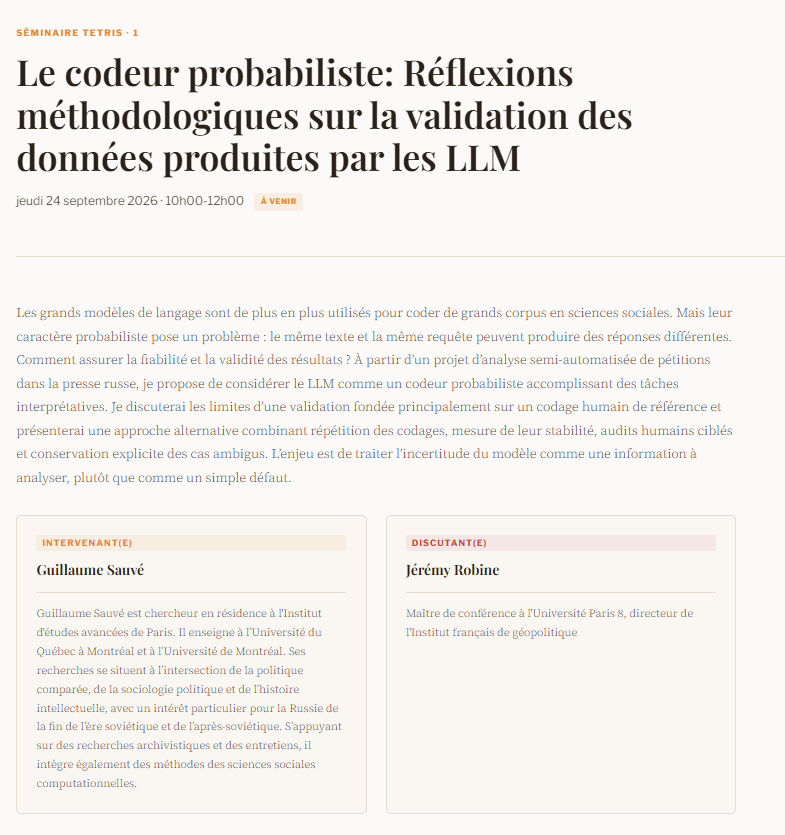 Talk by Guillaume Sauvé (Université du Québec à Montréal / Paris IAS) as part of the TETRIS Seminar, funded by the DECRIPT programme and hosted by INALCO and Université Paris 8. Open to the public. |
|
|