
David Fernando Salas Muñoz
  |
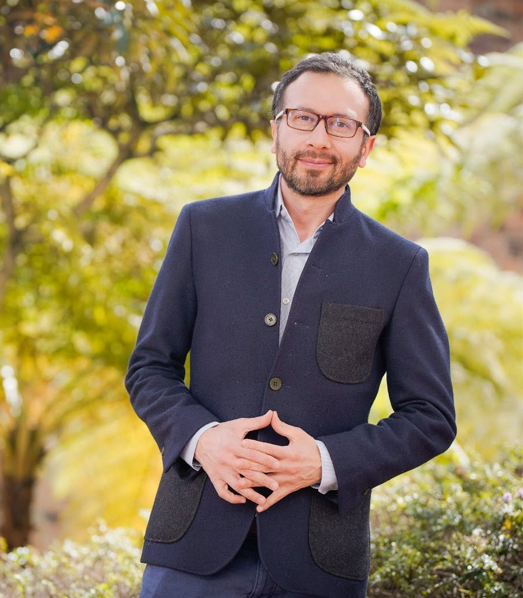
David Fernando Salas Muñoz is Director of Continuing Education at the Université of the Andes (Universidad de los Andes) in Colombia, where he designs and scales open courses, executive extension programs and corporate partnerships.
An industrial engineer with a master's degree in Engineering from Universidad de los Andes, he has taught leadership and systems-thinking courses at the university for over a decade. He is co-founder and former CEO of Disruptia, a social-impact startup that has placed over 1200 people facing systemic employment barriers into formal jobs, and co-founder of Somos CaPAZes, a peace-education organization active in more than seven countries. He also chairs the board of Seguros Beta. He is a Fellow of the E-Lab at Columbia University and of Acumen, and was selected for the United States Institute of Peace's Generation Change fellowship.
His current work focuses on embedding AI-related, university-validated micro-credentials into Colombia's social protection infrastructure to close the region's AI skills gap.
David Fernando Salas Muñoz joins the Paris IAS in December 2026 for one-month writing residency.
Research topics
Continuing Education; Artificial Intelligence and the Future of Work; Micro-credentials and Stackable Learning Pathways.
Leveling the Field: AI and Micro-credentials in the Global South
Latin America faces a widening AI skills gap. A 2024, International Labour Organization (ILO) and World Bank study finds that while only 2-5% of jobs in the region face full automation, 26-38% are poised for transformation by generative AI, risking an "attainment gap" that could exclude millions of workers from AI-driven productivity gains. This project asks how existing social infrastructure, rather than new institutions, can be repurposed to close that gap.
It draws on a pilot program at the University of the Andes (Universidad de los Andes) that embeds university-validated, stackable micro-credentials into Colombia's compensation funds: Colsubsidio (95,000 companies, 2.8 million workers), Comfandi (47,000 companies, 1.3 million people), and, at national scale, ASOCAJAS, reaching over 750,000 companies and 10 million workers. In an AI leadership credential, participants starting from little or no AI knowledge saw perceived competence rise by 140%, and the high-risk group fell from 48% to 9%, as use shifted from reactive tasks to strategic decisions - an "Upward Leveling" effect the project seeks to formalize.
Beyond this case, building on the university's ties with Sciences Po and Sorbonne Université, the project develops a general framework for micro-credentials as instruments of equity, and asks how such infrastructure-based models could be adapted across other countries in the Global South facing similar attainment gaps.
Key publications
Daniel Salas, ¿Podrán las máquinas ayudar a asumir los grandes desafíos de la humanidad?, dans Liderazgo Sostenible: Las Lecciones de Hoy para los Retos del Futuro, Publicaciones El Espectador, 2018
Daniel Salas et Carlos Olaya, Darwin en el aula: conjetura sobre la posibilidad de una educación seleccionista, 12th International Conference on Philosophy of Education, Universidad de los Andes, Colombia, 2010
Daniel Salas et Carlos Olaya, No More "Learning": Selectionist Education for the Classroom, 21st Annual Meeting of the Human Behavior and Evolution Society, California State University, Fullerton, CA, USA, 2009
|
|
|
|
|
|